How Diátaxis Turns Documentation Chaos into Clarity

Let’s be honest, working on documentation can feel overwhelming. It’s easy to feel stuck when you’re staring at a blank page, or you’re trying to clean up existing content. That’s where Diátaxis comes in.
Instead of following the pattern of following rigid rules and overwhelming plans. Diataxis offers you a refreshing approach: take things one step at a time, let the structure emerge naturally, focus on making small, meaningful improvements. The best part is that you don’t need to fully understand it before diving right into it. With Diátaxis, you learn by doing, taking small, meaningful steps to transform your docs into something clear.
Diátaxis: A Guide, Not a Plan
Diátaxis, at its core, offers a complete picture of documentation without imposing rules that are too rigid. It’s more like a guide that helps you understand where your documentation is and where it needs to go. Unlike following the traditional way of prioritizing extensive planning, Diátaxis advocates for adaptability and incremental progress.
Diátaxis encourages writers to focus on small changes instead of striving for immediate perfection. Over time, with these improvements, the documentation shapes into more of a clear user-focused structure without forcing it into already predefined categories.
Avoid top-down structures
When writing following the traditional writing process, it’s often emphasized that you should start with a clear structure: divide the content into tutorials, how-to guides, reference materials, and explanations.
However, Diátaxis warns against this approach. Instead of creating empty sections for future content, which is counterproductive and frustrating, you should let the structure emerge naturally.
This is done by addressing what the user needs at that specific time and improving the content piece by piece; then your documentation will organically align with the Diátaxis framework. This inside-out development makes sure the structure reflects well-formed content.
The Power of Small Steps
One of Diátaxis’ key principles is iterative improvement. Even if your documentation feels like an unmanageable mess, there’s always a way forward by taking it one small step at a time. Here’s how to apply this method:
- Choose a starting point: Select any piece of documentation. It could be a page you last read or even a frequently referenced section. Don’t waste your time searching for the “perfect” starting point.
- Assess it critically: After selecting, evaluate the selected content and ask yourself these questions:
- What user need does this address?
- How effectively does it serve that need?
- What changes could enhance its value?
Then consider how clear, logical, correct, and useful the content is.
- Make a decision: Once you’ve answered the questions above, identify one immediate action to take that will improve the content, whether it’s rewriting a sentence, adding an example, or clarifying instructions.
- Execute and Publish: Simply implement the change and publish your content. It’s best to avoid the temptation of waiting until you’ve completed a larger part. Every small improvement counts.
- Repeat: Repeat this process from step one and continue iterating.
By using this approach, you’ve reduced decision paralysis and progressed steadily. This keeps your documentation consistently aligned with what your users need.
Organic Growth: A Living System
Diátaxis likens documentation to a living organism, emphasizing well-formed organic growth. Just as a plant develops from a healthy seed into a mature tree, documentation evolves through iterative improvements at the “cellular” level, these include individual paragraphs, sentences, or sections.
When each component is carefully nurtured and improved, the overall structure emerges naturally, adapting to external conditions like user feedback and product updates. This type of growth fosters better, more resilient documentation.
Complete, Not Finished
A defining concept in Diátaxis is the difference between what is complete and what is finished. Documentation, like a living organism, is never truly finished because it must continuously evolve alongside the product and its users. However, it can always be completely useful, appropriate, and ready for its current stage of development.
Imagine a plant at every stage of its life. From a seedling to a fully-grown tree, it is always complete in its own right, even as it continues to grow and mature. Documentation can follow the same principle: providing value to users at every stage while remaining open to future refinements.
The Four Modes of Documentation
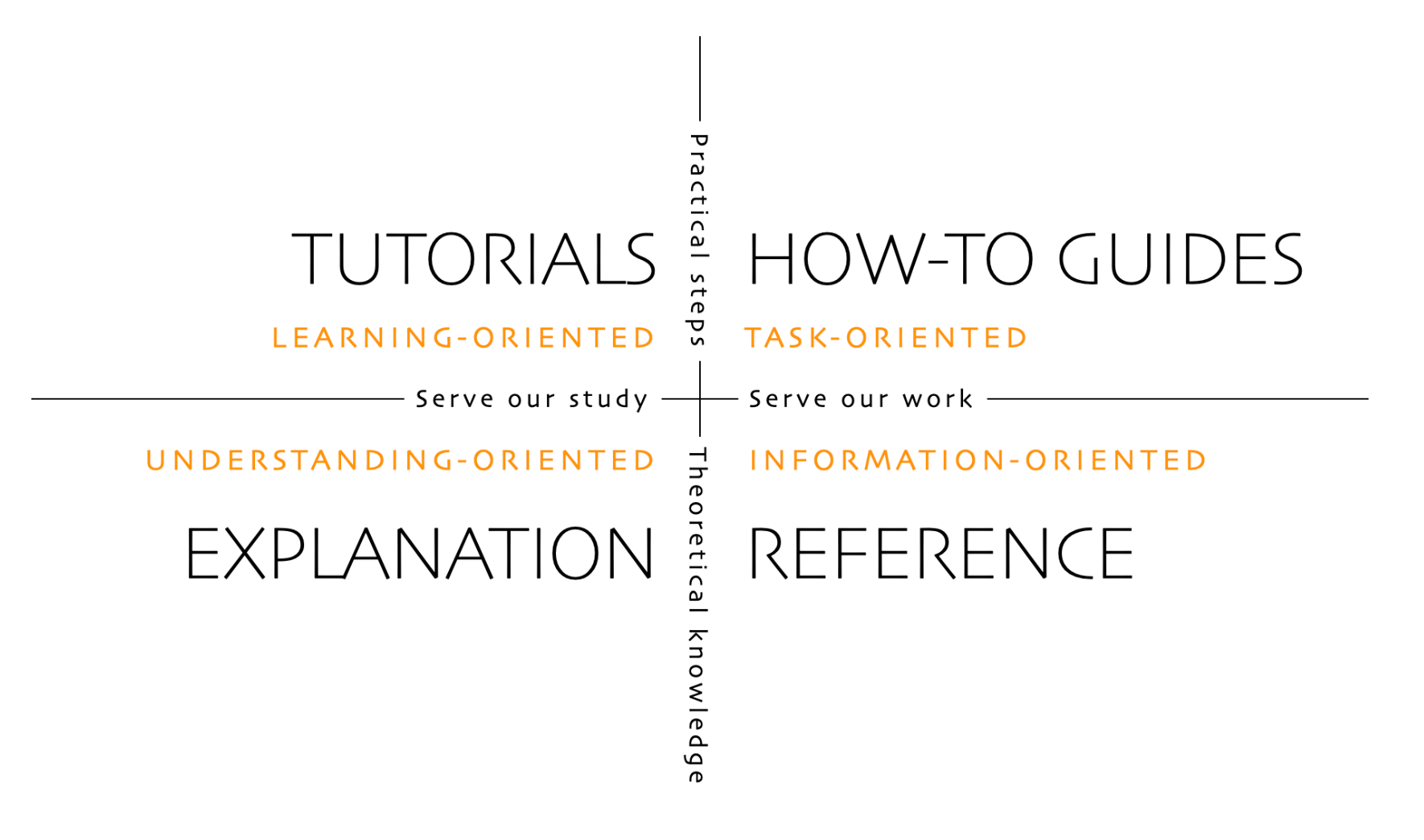
Image of Diátaxis Framework
Diátaxis framework groups documentation into four distinct modes, each of which serves a specific purpose:
- Tutorials: Learning-oriented experiences that guide users through a process step by step.
- How-to Guides: Goal-oriented instructions for accomplishing specific tasks.
- Reference: Technical descriptions focused on providing precise, factual information.
- Explanations: Understanding-oriented discussions that dive into the why and how of a topic.
By iterating on your content with these modes in mind, your documentation will naturally take on a shape that serves the diverse user needs.
Navigating Common Challenges
Applying Diátaxis can feel counterintuitive at first, especially if you’re used to traditional documentation practices. Here are some practical tips to navigate common challenges:
- If you’re overwhelmed by existing content, you should start small. Focus on one paragraph, page, or section at a time. No matter how incremental, progress is still progress.
- If you’re tempted to restructure everything at a time, resist! By tearing down an entire documentation, you’ve already introduced unnecessary complexity. Instead, build on what you already have by improving it step by step.
- If you’re struggling to define user needs, use the feedback from real users. Most of their questions and challenges can help guide you in deciding what your priorities are thereby ensuring your documentation addresses users needs.
Conclusion
Diátaxis transforms documentation from a complex task into a manageable, iterative process. By focusing on small, meaningful changes and allowing the structure to emerge organically, this approach empowers writers to produce user-centric, adaptable documentation. Whether starting from scratch or refining a chaotic documentation, Diátaxis offers the tools and principles to guide you toward clarity and success one step at a time.
Understand that with documentation, it’s not just a deliverable. Rather you should see it as a dynamic and evolving process. With Diátaxis, you can embrace the process with confidence that every small step contributes to a clearer, more effective documentation.